
Freretown, located a short drive from Mombasa CBD holds a significant place in the history of East Africa as a settlement established for freed slaves in the late 19th century, many of whom had been captured from regions as far as Nyasaland (Malawi), Mozambique, Tanganyika (Tanzania), and Southern Rhodesia (Zambia) and Northern Rhodesia (Zimbambwe). Its origins are tied to the abolition of the East African slave trade. Slavery was officially abolished in 1807 but it was still rampant late into the 19th century. The HMS Leven British Naval survey ship which docked at Mombasa Old Port in 1824 was the first to be credited for the fight against the illicit trade in humans.
Freretown was founded in 1875 by the Church Missionary Society (CMS) and named after Sir Bartle Frere, a British official who played a key role in suppressing the slave trade along the East African coast. These freed slaves, known as ‘liberated Africans’ were brought to Freretown to rebuild their lives, and some had been brought to Kenya by the British after being trained as carpenters and masons in a CMS Asylum in Nasik, Bombay India. Some were settled at Freretown while others were taken to Rabai.
Both Rabai and Freretown were the first CMS centers that pioneered the formal western education and Christianity in the Kenyan coast before these activities were moved to other inland parts of the country like Thogoto in Cental Kenya and Maseno in western Kenya (Patrick Abungu)
Freretown was not only a refuge but also a hub for Christian missionary activity. When the Freretown population increased, the Church Missionary Society built a makeshift school where the freed slaves were taught languages. By the time Dr Johann Ludwig Krapf arrived at the Coast in 1844, plans to build a church had been worked out, but the first church was built at Rabai in 1887 instead of Freetown and was known as St Paul’s Church. The CMS also established vocational training programs to equip them with practical skills such as carpentry and masonry. The settlement also became an important site for early African converts to Christianity, with some going on to become ordained ministers.
Originally, Freretown sat on 600 acres of land between Kengeleni, Mkomani, Nyali and Junda in Mishomoroni. However, in 1930, there was a disagreement between the missionaries and the freed slaves, which resulted in the sale of the land to a company called Nyali. The descendants of freed slaves were later resettled on 50 acres at the new Freretown in Kisimani. The British Government used to give the community 40 pounds per month for the maintenance of Freretown but the grant was stopped after Kenya gained independence.
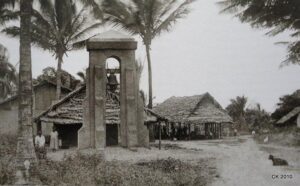
In order to warn the people of Freretown whenever Arab slave ships were approaching, a huge bell which is still present today (though the original copper bell which weighed approximately 300 kgs was stolen some time ago) was installed and it would be rang whenever the ships were sighted. It was later used as a call to Church and prayer to the ACK Emmanuel Church (completed in 1889), just opposite the site of the bell, for those that adopted Christianity. Mombasa was a crucial a crucial transit point for slave ships and when the abolition efforts intensified, slave traders shifted to Shimoni in South Coast where slaves were shipped to Zanzibar, Arabia and as far as Mauritius.
This ‘tribeless’ group emerged as a self-aware urban elite who viewed themselves as instrumental in shaping the Kenyan nation. Their adoption of Christianity, Western education, and close association with colonial authorities positioned them as loyal collaborators during the colonial era. However, this alignment came at a cost. The post-independence Kenyan constitution, which retained colonial categorizations based on ethnicity, marginalized them by failing to recognize them as a distinct ethnic group. Consequently, they were excluded from fully participating in the socio-political fabric of the emerging nation.
This exclusion left them grappling with a dual stigma— the historical discordance of their slave ancestry and their perceived “otherness” within Kenyan society. Despite their contributions to Kenya’s independence and nation-building, they were denied rightful recognition and faced daily discrimination. In 2007, descendants of the community began advocating for acknowledgment of their heritage and citizenship rights, aligning their struggle with other marginalized groups.
Their experience highlights the complex interplay between inclusion and exclusion in post-colonial citizenship practices. While they sought to define themselves as ‘good citizens’ through education and cultural assimilation, structural barriers rooted in colonial legacies have continued to hinder their full integration into Kenyan society. Their story underscores broader issues of minority recognition and the challenges of forging an inclusive national identity in post-independence Kenya.
The most famous descendants of Freretown include the late famous radio broadcaster Leornard Mambo Mbotela and his uncle Walter, Bhango maestro Mzee Ngala, the late Francis Khamisi (father of former Bahari MP Joe Khamisi), Mombasa deputy mayor John Mcharo among others.