
“In the end there will be two histories, theirs and ours. Ours will…satisfy us, while theirs continues to satisfy them.” (Spear [1981:178])
The Swahili coast is both a contested place, in regards to cultural identity formation and its somewhat painful narratives. Identity has been key in defining place and people, and even today, youth in urban Swahili spaces like Mombasa still struggle in finding a proper definition for their cultural identity without ascribing it to Arab ancestry. This kind of dissonance has a long history, going all the way back to the British colonial period and shortly after the post-colonial time after Kenya gained its independence from Britain.
To be Swahili, in the colonial period, was to be a disposable in-between. One was either classified as African- hence, inferior- or Arab, which came with a certain level of prestige. Thus, for Swahilis to claim prestige and fair treatment by the British, they had to affiliate their ancestry to Arabness. Even then, for a Swahili to gain access to institutions of education like the Arab Boys, they had to prove this Arabness. As Kenya gained independence, the same paradox was to haunt the Swahilis as the young nation did not recognize this as a tribe, a notion propagated in pedagogy as well, with history postulating that Swahilis were as a result of local and Arab intermarriage. Even in the early decade of the 21st Century, getting national ID cards for Swahilis in coastal Kenya was still problematic, a phenomena that has greatly contributed to the condition alluded to in the first paragraph above.
Even so, contemporary scholars have all refuted the idea of foreign ancestry for the Swahili, marking them as an authentic African people with unique civilizations that predate Arab influence. In this article, we will trace this history over space and time, borrowing heavily from the well-detailed work “The Swahili World” collected and edited by Stephanie Wynee-Jones and Adria LaViolette. Still, as we briefly describe the chronology that will somewhat enable us to render some sort of definition to the Swahili, we must remember that definitions are based on different perspectives, and as the “The Swahili World” notes, ‘…we must attempt to resist compressing the Swahili world to a single identity or history.”
1st – 5th Century BCE: Rhapta
The area had been populated way before the mid-first millennium by iron-using mixed farming communities who interacted with cattle pastoralists, hunter, gatherer and other farming societies. The classical period merchant sailors interacted with these communities who were (…) makers and users of Early Iron Age Urewe and Kwale Ceramics which span the coastal area including interior regions, suggestion the existence of interactions between the coast and hinterland that early on.
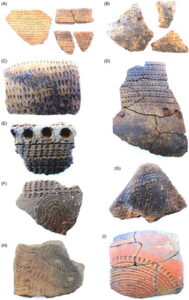
Urewe ceramics, named after a type site in central Kavirondo, Kenya, are associated with early farming communities speaking Bantu languages in the Great Lakes region of East Africa. These ceramics represent the earliest manifestation of EIA pottery in the area. Initially found west of Lake Victoria, Nyanza in Rwanda, Burundi, and even in northwestern Tanzania, they later appeared in areas of Rift Valley (Ashley & Grillo). Kwale ceramics are quite similar to Urewe and we have a third called Lelesu in Central Tanzania that have similarities of both. (Soper)
The Periplus of the Erythraean Sea, a navigation manual written by a Greek sailor sailing from Roman Egypt to some areas along the Swahili coast and to Southern Arabia and Indian ports, dating back to the 1st Century CE mentions ‘Rhapta’, the Roman’s southernmost trading port. Rhapta is yet to be identified on the ground, but this shows an interaction between people of the Swahili coast and foreign merchants. This was way before the Indian Ocean trade dynamics came to be as we have known.
In Judy Aldrick’s work “Kenya’s Swahili Coast from Roman Empire to 1888” (2024: 10) explains that “Rhapta means sewn in the Greek language and it was here the author of the Periplus mentions them (traditional sewn boats also known as Mtepe) …”