
The Santo Antonio de Tanna was a 17th-century Portuguese frigate that sank very close to Fort Jesus in 1697. Fort Jesus stands as evidence of Portuguese presence in Mombasa designed by the Goa-based Italian architect Giovanni Batista Cairato as his last and perhaps most crowning achievement. It remains more or less as he had designed it, save for the minor additions by the Omanis in the 18th and 19th centuries and an elliptical bastion added for extra protection to the entrance.
The sinking occurred when the Portuguese were struggling to maintain control of their Indian Ocean settlements and trade routes, facing challenges from the British, Dutch, and Omani Arabs. At this point, the Omani’s under the Ya’rubi ruling clan had a strong navy that had already taken over Portuguese forts and the trade route from Gujerat that the Portuguese had relied on for trade.
In 1696, a fleet including the Santo Antonio de Tanna was dispatched from Goa to relieve Fort Jesus. It successfully delivered supplies and reinforcements but lost anchors and suffered hull damage during several attacks. In October 1697, it was decided that the ship was beyond repair and was scuttled. It potentially sank while still unloading its cargo.
The ship was built at the Bacain/Bassein shipyard, 50km North of Bombay in 1680/1 and named after Saint Antonio. Tanna was the name of a small town near Bombay. Sources indicate that the frigate was actually built in two places, first in Bacain then completed 630km away in Goa. It was made of the best Teak wood, had three masts and rigged with square sails. Both its decks were equipped with 42 guns but a source indicates that more guns were added to make 5o before it headed for the rescue mission at Fort Jesus.
For the Mombasa mission, the ship was accompanied by 4 other ships under the command of Luis De Melo Sampaio; a 42-gun sister ship ‘Nossa Senhoro De Velle’, two galliots, the first loaded with 12 guns and the other a supply ship loaded wit ammunition and supplies, and these were accompanied by three ‘Manchuas’ that would bring the ammunition and supplies form the ships to the shore. In total, the crew numbered 750, of whom 400 were soldiers.
Galliots are smaller than frigates. Both ships were developed in the Mediterranean and spread across Europe. Usually, galliots have two masts, and the ones in the red sea are fitted with lateen sails. It’s small length of around 85-90 meters fitted with oars makes it maneuverable and it can carry small caliber guns. The Manchua is a smaller version of the galliot, probably inspired by the dhow design, and is usually fitted with one mast. The Indian Ocean ones have lateen sails. Fitted with twelve oars, Manchuas are very fast and ideal for quick landings and assisting larger ships.
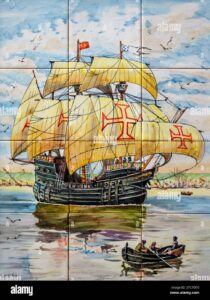
The santo Antonio and the other ships arrived and anchored off the reefs of Mombasa. One of the galliots, accompanied by Captain Jose Barosso at Fort Jesus who had gone to welcome and brief the squad about the situation, left and headed towards the Fort. Heavy enemy fire sunk the manchua, and only Barosso and a few soldiers survived. Disagreements between the crew however caused some divisions, and the San Antonio followed by a galliot sailed towards Mozambique while the ‘Nossa Senhoro’ sailed to Zanzibar. After their departure, five Arab ships entered Mombasa to reinforce their troops.
General Sampaio who had been named Governor of Mozambique received an urgent request in August 1697 to help the now besieged Fort Jesus, and he sailed on the San Antonio and a galliot to the rescue. The San Antonio arrived in Mombasa in mid-September and encountered heavy fire from the Omanis but still managed to keep offloading its cargo until October 1697. Noticing that the ship was damaged beyond repair, the General and a Council of officers decided to salvage and scuttle it, and it sank below the reef. A galliot wreck was to later be discovered near Mombasa Hospital and it is said to have sunk very close to the San Antonio.
The fighting at the Fort continued and the Portuguese surrendered in December 13 1698.
The San Antonio wreck was discovered in 1960 by two divers- Conway Plough and Peter Philips at a depth of 15 meters in the old Mombasa Harbor and excavated from 1976-80 by the institute of Nautical Archaeology and the National Museums of Kenya. 40 meters of its hull was still intact and more than 15,000 artefacts were recovered.