
Introduction and Identity
The Mijikenda (which translates to The Nine towns/tribes) are a cluster of nine distinct but related Bantu ethnic groups inhabiting the coastal region of Kenya, from the border with Somalia in the north to Tanzania in the south. They are one of the key cultural and political pillars of the Kenyan coast. Their shared identity is rooted in a common origin story, linguistic similarities (Mijikenda languages are mutually intelligible dialects), and core cultural institutions, most notably the sacred Kaya forests.
The Mijikenda term is a 20th century construct[1], changed in 1940 from the previous name, Nyika which means hinterland/bush. It is said Nyika was the term the Swahilis referred to them by.
The traditional Mijikenda tribes can be divided into groups, either according to their language, location, or cultural traditions.
When divided by language they group as follows:
- Rabai, Ribe, Jibana, Kauma, Kambe, Chonyi, Giriama
- Duruma
- Digo
When divided by the location of the tribes, they can be separated into two groups:
- Northern: Rabai, Ribe, Jibana, Kauma, Kambe, Chonyi, Giriama
- Southern: Digo, Duruma
Origins and Migration (c. 1500-1700 AD)
The history of the Mijikenda begins with a great migration. Oral traditions consistently narrate that their ancestors migrated from a mythical place called Shungwaya, located in what is now southern Somalia/northern Kenya. The exodus is attributed to a combination of factors which include pressure from Cushitic Ormo (Galla) pastoralists. One oral narrative suggests that the reason the Ormo pushed the Midjikenda away was an incidence where a young Mijikenda man killed an Ormo tribesman.
The migration was not a single event but a series of movements by different groups over a considerable period (roughly the 16th and 17th centuries). As they moved south along the coast, they eventually settled in the fertile hilltops of the Kenyan coastline, each group establishing its own fortified village, known as a Kaya.
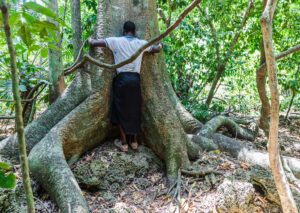
The Kaya: The Heart of Mijikenda Civilization
The Kaya is the most significant cultural and historical institution for the Mijikenda. These were not just villages but fortified forest settlements surrounded by dense, sacred forests.
Functions of the Kaya:
- Fortification: The dense forest and hidden paths provided protection from enemies, including the Oromo and later, slave raiders.
- Political Center: The Kaya was the seat of governance, where a council of elders (Kambi) met to make decisions, settle disputes, and administer justice.
- Religious and Ritual Center: It was a spiritual nexus where the community communicated with their ancestors (Mizimu) and God (Mulungu). Rituals, sacrifices, and prayers for rain, peace, and good harvests were conducted here.
Identity and Symbolism: Each Mijikenda subgroup derives its name from its specific Kaya (e.g., Giriama from Kaya Giriama, Duruma from Kaya Duruma). The Kaya symbolizes the physical and spiritual point of origin for each community.
Today, the Kayas are recognized as UNESCO World Heritage Sites as “The Sacred Mijikenda Kaya Forests,” protected for their immense cultural and biological value, though people no longer live in them permanently.
Learn more about the Kaya forests here
The Slave and Ivory Trade:
The Mijikenda were both victims and participants in the Indian Ocean slave trade. While some were captured, others acted as middlemen, porters, and guides for Arab and Swahili caravans heading into the interior. This created internal social stratification and tensions.
Colonial Era (British Rule):
The arrival of the British in the late 19th century profoundly disrupted Mijikenda society. This was foretold by a mythical woman called Mepoho who was found near a pond in Kaloleni as an infant by a group of women after a night of hard rain. She grew up and became a diviner who saw the coming of the white people and the subsequent theft of native land to serve colonial purposes. [2] After this prophecy, it is said that the earth opened up and swallowed her.
The Giriama Uprising (1914-1915):
This was the most significant resistance against British rule. Led by a charismatic prophetess Mekatilili wa Menza and her elder Wanje wa Mwadorikola, the Giriama revolted against forced labor, conscription, and land alienation. Although brutally suppressed, the uprising became a foundational symbol of Mijikenda resistance and pride.
Artistic expressions:
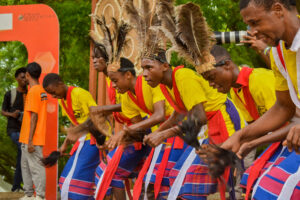
- Sengenya Dance: one of the most famous Mijikenda dance forms. The dance is vigorous with fast footwork and energetic body movements. It is performed by both women and men,
- Mwanzele: a slow, poetic dance performed by elders. This dance is usually accompanied by songs that tell/retell history and stands as a potent form of inter-generational knowledge transfer.
Prominent Individuals in Mijikenda History
Several individuals have played pivotal roles in shaping and representing the Mijikenda community.
- Mekatilili wa Menza (c. 1840s – 1924)
Role: A legendary prophetess and freedom fighter from the Giriama community.
Significance: She was the spiritual leader of the 1914-1915 Giriama Uprising against the British. She used powerful traditional oaths and public rallies to mobilize her people to resist colonial policies. She is now a national heroine in Kenya, symbolizing courage and the fight for justice. Her statue stands in Uhuru Gardens, Nairobi.
- Wanje wa Mwadorikola
Role: An elder and the military strategist of the Giriama Uprising.
Significance: He worked alongside Mekatilili, providing the organizational and tactical leadership for the resistance. While Mekatilili was the spirit, Wanje was the backbone of the rebellion.
- Ronald Ngala (1923 – 1972)
Role: A prominent post-independence politician and statesman from the Giriama community.
Significance: He was a founding father of Kenya and a major political figure in the coastal region. He led the Kenya African Democratic Union (KADU), which advocated for a Majimbo (federal) system of government to protect the interests of minority communities like the Mijikenda against the dominance of larger groups. He served as a Cabinet Minister and was a key figure in Kenyan politics until his death.
- Karisa Maitha
Role: a prominent politician and minister in President Mwai Kibaki’s government.
Significance: Emmanuel Karisa Maitha served as the Kisauni MP from 1997 to his death in 2004, aged 50, and as Minister in the Local Government and Tourism & Wildlife docket. Known as “Hurricane”, he had a tendency of making impromptu visits to government institutions and sacking senior staff in cases of irresponsibility in public service.
[1] Spear, 1978