
Msanifu Kombo
Msanifu Kombo was elected Mayor of Mombasa during the KANU-KADU coalition government (1962–1964). His victory coincided with KADU’s dominance in Mombasa, where local leaders like Abdillahi Nassir and Anantprasad Pandya opposed KANU’s centralization. Kombo’s rise likely aligned with Oginga Odinga’s faction of KANU (which later became Kenya People’s Union, KPU), which emphasized regional autonomy and socialist reforms. However, aligning with the firebrand Odinga was to also later spell his fall-out with the then Head of State, Jomo Kenyatta, and his political demise. His leadership coincided with significant political and social shifts in Kenya, particularly in the coastal region, which was marked by factionalism, ethnic rivalries, and struggles for central control.
Most coastal politicians were either affiliated to Ngala’s KADU or the secessionist Mwambao movement, as the Coast Peoples Party was called. The Mwambao movement were calling for the return of Mombasa under Zanzibari rule. At that point, several coastal politicians including Kombo, Salim Mohamed Balala and Mohamed Jahazi strategically placed themselves as pro-Kenyatta, strongly against the likes of KADU’s Joseph Gideon Ngala, Shariff Nassir and Robert Matano. This earned them special places in the Kenyatta regime as Kombo went on to become mayor, Balala names assistant minister for finance while and Jahazi was appointed as assistant minister for health in 1969. Jahazi was to dislodge Anantprasad Pandya in the Mvita (Mombasa Central) parliamentarian seat later, and then he was to lose the same to a fiery Sharrif Nassir in 1974.
In 1966, Odinga held a rally in Kwale County that Kombo hosted, signaling his alignment with Odinga’s socialist-leaning faction. This move—which mid-wifed KPU— angered Kenyatta, who viewed Odinga’s activities as a threat to his authority. Kombo’s perceived support for Odinga led to his marginalization within KANU and eventual loss of the mayoralty.
Kombo lost the mayoralty in 1966 amid KANU’s consolidation of power after KADU dissolved into KANU in 1964. His defeat mirrored broader shifts as KANU sidelined opposition figures, including KADU allies and Odinga’s supporters. KADU’s collapse left Mombasa’s local leaders vulnerable to KANU’s centralization, eroding regional autonomy. Kenyatta sidelined Kombo, replacing him as Mombasa KANU chairman with Ngala in 1965. Kombo’s loss of the mayoralty in 1966 further diminished his influence, reflecting Kenyatta’s consolidation of power against dissent.
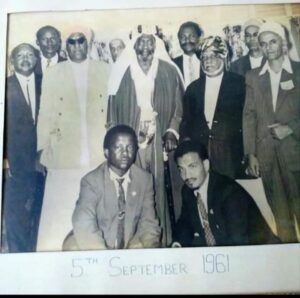
Kombo’s tenure was shaped by intense factionalism within Mombasa’s political landscape. As the head of the KANU branch in Mombasa, he had to navigate power struggles between local leaders aligned with Ronald Ngala (KADU) and those loyal to Jomo Kenyatta (KANU). The dissolution of KADU in 1964 and its merger into KANU further complicated regional politics, as many former KADU leaders retained influence in the Coast region. Kombo had to balance competing interests while maintaining loyalty to KANU’s central leadership.
Around the same time during the 1966 Kwale rally, another politician from Kwale Kassim Mwamzandi who served as Kenyatta’s Assistant Minister for Foreign Affairs was accused of having allowed the rebellious factions to hold rallies in his backyard, with Kenyatta blasting him in a rally held in Diani to counter the Odinga-led Shimba Hills, Kwale rally. Mwamzandi was to stand his ground at the Diani rally, explaining to Mzee that he had nothing to do with the Kwale event. This brought Mwamzandi closer to Mzee, a closeness that would see him as Kenyatta’s point man in the coast and play constant host to the head of state as he chose Mwamzandi’s Msambweni backyard as his entertainment joint. He took to holding events at Msambweni and Bomani primary schools, the latter which was to be renamed Jomo Kenyatta primary school. Jomo Kenyatta is said to have passed away while in Mswambweni in 1978, though other sources indicate that he got ill while at Msambweni and passed away at State House Mombasa. Mwamzandi was away in Switzerland on official ministerial duties during Kenyatta’s demise.
Kombo’s fall-out with Kenyatta is however controversial. During the said 1966 Shimba Hills rally and talks of an Oginga led coup, sources close to Kombo say he was not part of the rally and that he was in fact in Mombasa seeing to his mayoral duties. At the same time, it is said that Abdulrahman Babu, a man with Marxist leaning and connected to the Afroshirazi revolt of Zanzibar in 1964, was in Mombasa. Kenyatta was unhappy with Kombo that Oginga had organized the Shimba Hills rally within his (Kombo’s) reach and this exacerbated the fall-out. Some also say it was a plan to make Kombo less popular amidst the dynamics of racialized power struggles within the Kenyan coast that also saw the rise of Ngala.
As Jomo Kenyatta and Kombo’s relationship waned, other coastal leaders like Ngala flourished, and after the 1966 lose to John Mambo, a Kanu-loyalist for the mayoral seat, Kombo lived a quiet life until his demise.
The late Msanifu Kombo has a minor road named after him within Mombasa’s CBD.
(Some of the info above has been received with gratitude through Msanifu Kombo’s grandson by the same name)