
Introduction and Identity.
The Pokomo are a Bantu ethnic group native to Kenya, exclusively residing in the Tana River County along the lower and middle basins of the Tana River, Kenya’s longest river. They are a riverine people whose entire culture, economy, and social structure are intrinsically linked to the seasonal rhythms of the Tana. They are distinct from, but historically related to, their neighbors, the Mijikenda and the Swahili coast peoples.
They speak the Pokomo/Kipfokomu language, which is similar to Swahili and belongs to the Niger-Congo language family. The Pokomo are divided into eleven sub-groups (Ndera, Malalulu, Zubaki, Kinakomba, Gwano, Ndura, Mwina, Ngatana, Dzunza, Buu and Kalindi).
Linguistically and culturally, the Pokomo can be classified under three sub-groups, namely; Upper Pokomo, Lower Pokomo and Malakote/Milakote. The Upper Pokomo are called Milajulu, the Lower Pokomo Milanchini and Malakote connotes culture from both sides (here referring to blended culture of Pokomo and Orma/Somalis/Borana).
The Upper Pokomo (or Wantu wa Julu- people from upper) settled along the river and the hinterland on both sides of the river while the Lower Pokomo settled mostly in the Tana Delta, all the way to the mouth of the river where it drains into the Indian Ocean, some also settled as far as the Lamu archipelago.
As far as linguistics are concerned, both the UP and LP refer to their language as a “two week language” (meaning it is faster to grasp) while they refer to the Malakote as a “two-month language”, perhaps due to its Orma influences and slight complexity.

Fun fact about the Pokomo: The Pokomos are the only tribe in the world with Kingozi language in use today. Kingozi language is the precursor of Swahili.
Origins of the name “Tana”.
The name Tana is a product of early European phonetic simplification. Before the arrival of Europeans spreading Christianity, local communities used distinct terms based on the river’s perceived size and location:
- Local Terminology: The Lower People (LP) referred to the vast watercourse as “Tsana”, a term that simply meant “the river”, as it was the dominant body of water in their experience. Smaller waterways were correctly categorized as Muho or Mukondo (streams).
- Upper Terminology: Conversely, the Upper People (UP) may have used “Chana Maro” or “River Maro.” Notably, the word “Chana” also means “river,” indicating its use as a common descriptor.
- European Simplification: When the first Europeans arrived, they found the local pronunciation of “Tsana” difficult to articulate. They adopted the simpler, more easily pronounced version, “Tana,” which then became the official name for the river.
It is also said to have Gikuyu origins or influences as they (Gikuyu) called the river “Chania”
The Ngadji
The Pokomo people of Kenya’s Tana River valley once worshiped their god through the vessel of an awe-inspiring drum known as the Ngadji. This sacred artifact, fashioned from a hollowed-out tree trunk and standing taller than any man, was the heart of the community. Its massive cowhide surface, when rubbed, produced a sound so profound it echoed across every village clustered near the king’s compound. As His Majesty Makorani-a-Mungase VII, the current Pokomo King, recounts in a published article, “Our legend has it that it sounds like a lion’s roar… It forced everyone to listen. It was alive.” For the Pokomo, the Ngadji was the ultimate source of their pride, power, spiritual authority and a tangible symbol of their identity.
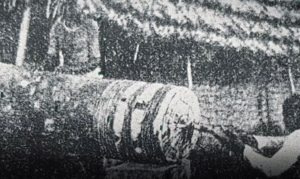
Tragically as with most other artefacts from African communities, this revered symbol of Pokomo sovereignty has been relegated to a storage room in the British Museum in London for over 111 years. The story of the Ngadji’s theft is a well-known trauma among the Pokomo elders: it was confiscated by British colonial officers before being donated to the museum’s collections in 1908. While the British Museum acknowledges this history and is aware of the Pokomo community’s formal request for its repatriation, the sacred drum is a reminder of colonial acquisition and a focal point in the ongoing debate over the return of cultural artifacts.
Read more about the Ngadji drum here
Religion:
Mulungu (UP) or Mungu (LP) is the universal being of the Pokomo, referring to God the creator of everything. The Pokomos traditionally had one religion, guided by a group of spiritual elders among the kijo. Kijo members would seek guidance at sacred prayer areas in the riverine forests.
The majority of the Upper Kokomo are Muslims. Conversions to Islam began in the latter half of the 19th century due to Swahili influence and by the end of the century, most were Muslim. Most of the Lower Pokomos are Christians, beginning to convert to the religion in the late 1870s, and, by 1914, had almost exclusively converted.
Artistic expressions:
- Kitoko: performed by everyone during weddings, birth and any joyful celebrations.
- Mwaribe: danced by young girls to the beat of a drum during circumcision time. The traditional costume is grass skirt made from the fronds of the Doum Palm (Mkoma leaves) worn especially by boys.
The Kenya National Anthem: a Pokomo lullaby
The National Anthem as we know it was derived form a Pokomo lullaby composed by the late Mzee Meza Galana Morowa (1920 – 2015) who was by the time of its composition a school teacher in Tana River. The anthem was composed into its form by a group led by Graham Hyslop, A British-born musicologist and Kenya’s Inspector of Music in the Ministry of Education. He led the All saints Cathedral and Alliance Boys choirs in composing the English version of the anthem.
Mzee Morowa was never credited at all and he lived in abject poverty until his death in 2015.
Famous cuisine:
The Pokomo eat Tana river catfish (mtonzi, or, if it is the largest, it is called mpumi), tilapia (ntuku), trout (ningu), eel (mamba) and crocodile (ngwena). Catfish are mainly boiled or sun dried/smoked.